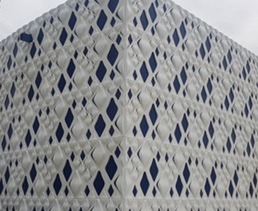
Ultra-High-Performance Concrete (UHPC)
Ultra-high-performance concrete (UHPC) is an advanced cementitious material with high strength and excellent durability. It offers the potential to become a practical solution to improve the sustainability of buildings and other infrastructure components. For the past two decades, UHPC is gaining increased interest in many countries with the usage ranging from building components, bridges, architectural features, repair and rehabilitation, vertical components such as windmills towers and utilities towers to oil and gas industry applications, off-shore structures, hydraulic structures and overlay materials. Station Co. is engaged in producing UHPC elements in accordance to the client requirements.
UHPC is a relatively new generation of cementitious material with very high strength, ductility and durability. UHPC strengthened with fiber can be treated as a combination of three concrete technologies: self-compacting concrete (SCC), fiber reinforced concrete (FRC) and high-performance concrete (HPC). French interim recommendations (AFGC 2002) defined UHPC as a concrete with a characteristic compressive strength of at least 150 MPa with the use of steel fiber reinforcement to ensure ductile behavior under tension. UHPCs with compressive strength of 130 MPa – 150 MPa strengthened with either steel or other fibers are considered as lower strength UHPC. Normally, the term UHPC is used to describe a fiber reinforced, super plasticized, silica fume-cement mixture with a very low water to cement ratio (W/C), characterized by the presence of a very fine quartz sand that ranges from 0.15–0.60 mm in diameter, instead of the ordinary aggregate.
UHPC has a compressive strength 10 times that of traditional concrete. Compressive strength is the ability of a material to resist bending under a load (or in compression). Normal concrete used in bridges has a compressive strength of 3,000 to 5,000 psi. UHPC has a compressive strength of 18,000 to 35,000 psi. Another measure of strength is tensile strength or tension. This is how strong a material is when you pull it. While traditional concrete has a tensile strength of 400 – 700 psi, UHPC has a tensile strength of about 1400 psi. Ultra-high performance concrete (UHPC) is a cementitious composite characterized by high compressive strength, typically greater than 120 MPa, specific durability, tensile ductility, and toughness.
Properties of UHPC
Compared with ordinary concrete, ultra-high-performance concrete (UHPC) has excellent toughness and better impact resistance. Under high temperatures, the microstructure and mechanical properties of UHPC may seriously deteriorate. As such, we first explored the properties of UHPC with a designed 28-day compressive strength of 120 MPa or higher in the fresh mix phase, and measured its hardened mechanical properties at seven days. The test variables included: the type of cementing material and the mixing ratio (silica ash, ultra-fine silicon powder), the type of fiber (steel fiber, polypropylene fiber), and the fiber content.
The advantages of UHPC are numerous and typically include:
- Reduced costs such as mould fabrication, labor, maintenance and schedule.
- Highly mouldable and replicates form materials with extreme precision.
- Thinner sections and lighter weight than conventional and HPC concrete.
- Higher quality surfaces and nearly impermeable.
- High Ductility and Volume Stability.
- No steel reinforcing bar cages.
UHPC Applications
The ultra-high performance concrete market is widely accepted in residential high-rise buildings, owing to various advantages offered, which include durability, high strength, and protection from extreme weather conditions. The growth of the ultra-high-performance concrete (UHPC) market is largely associated with the growth in the residential applications in the construction industry.
The enhanced durability properties have primarily motivated the use of UHPC in bridge applications even in harsh environments. It has also been used in innovative ways to provide new solutions for architectural markets. These applications include bridge beams and decks, solid and perforated wall panels, urban furniture, louvers, stairs, large-format floor tiles, pipes and marine structures.